

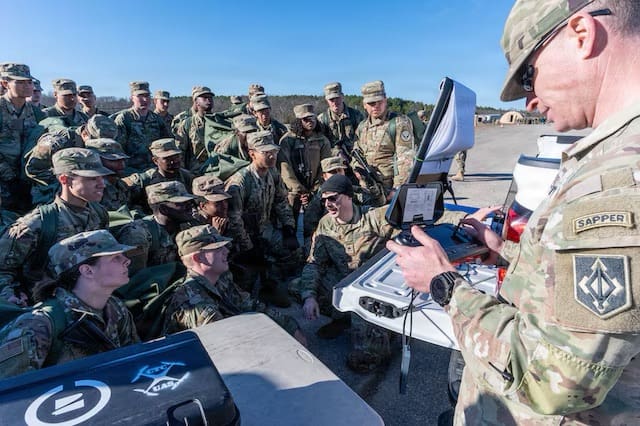
Facing the gap head-on
Training units push airframes harder than ever. That amplifies small faults into mission failures. Start simple: align the sensor stack, verify telemetry, and make sure the ground control station responds. This problem-driven note ties straight to practical courses like drone training for military, which focus on operational readiness. Fort Benning and other active ranges show how field wear reveals hidden calibration gaps during large exercises — real conditions, real consequences. Stay sharp. Stay ready.

Why precise calibration matters
Calibration is the difference between a usable feed and a wasted sortie. A misaligned payload sensor or sloppy IMU zeroing skews targeting and autonomous waypoint navigation. That costs time and can expose crews. Keep calibration routines tight: sensor offsets, compass declination, and flight envelope checks must be routine. You train pilots to improvise; don’t force them to compensate for preventable technical drift.
Field maintenance checklist that actually works
Make this your pre-mission ritual. Quick, repeatable, effective.- Power and battery health: verify charge, internal resistance, and correct cell balancing. – Firmware and config: confirm version parity between airframe and ground control station (GCS). – Sensor warm-up and calibration: let gyros and barometers stabilize; run IMU and compass checks. – Radio and telemetry: test link strength, packet loss, and frequency clearance. – Payload and mounts: secure lenses, gimbals, and wiring; check payload sensor alignment. Do the steps in that order. It’s short. It’s non-negotiable. — A rushed checklist invites error.
Embedding maintenance into training syllabi
Programs must teach maintenance as core missioncraft. Add hands-on modules for ground crews and pilots that mirror live ops. Blend simulation with field calibration drills: live tuning of PID and flight envelope adjustments during tethered flights. Equip students to execute a GCS-led preflight scan and to interpret telemetry logs. And expand access—scale programs for wider teams so units can support one another during deployments focused on military training more drone pilots.
Common mistakes that trip teams up
Teams repeat avoidable errors. Fix them fast.- Skipping sensor re-zero after transport. Quick fix: re-run IMU and compass calibration on-site. – Ignoring minor vibration signatures. Quick fix: inspect mounts and dampers, then log vibration telemetry. – Overlooking firmware mismatches. Quick fix: standardize a verified firmware build for the unit and lock updates until validated. A little discipline here saves sorties and preserves trust between pilots and techs.
Three golden rules for selection and evaluation
Use these metrics to choose tools and set program priorities.- Reliability under stress: prioritize systems with field-proven uptime and clear failure modes. – Maintainability in the field: choose platforms with modular payloads, documented calibration steps, and accessible spare parts. – Data clarity and telemetry quality: ensure logs reveal root causes quickly; raw telemetry should be readable and actionable. Follow these. Measure against them after every major exercise. Expect measurable gains in sortie success and reduced troubleshooting time — tangible outcomes that commanders value. Conclude training cycles with verified checklists and repeatable logs.
Final note — short, direct
Field maintenance and tight calibration are not optional. They’re mission enablers. For programs that want practical guidance and field-proven templates, Military Hub collects lessons, checklists, and course links that teams can adopt immediately — a practical source for durable readiness. — End on discipline.