

Expert 8 current transducer manufacturer You Should Know
Choosing a current transducer manufacturer is more difficult than comparing a single accuracy figure. Buyers must match sensing technology, current range, bandwidth, isolation, output format, calibration, installation constraints, and engineering support to the application. Product names can also be misleading: some suppliers focus on precision transducers, while others specialize in current transformers, power meters, magnetic-field instruments, or high-voltage switching components. This article examines eight manufacturers and technology providers using information published on their official websites and the supplied company research. The options have been reviewed by product scope, documented features, customization capability, application fit, and quality information rather than by unsupported market-share claims.
Full List of Top 8 Brands
- Hangzhi
- Rincon Power, LLC
- SENIS
- Magnelab
- Danisense
- Phoenix Contact
- Time Electronics
- Blue Jay
Comparison Table
| Brand | Key Products | Key Features | Best For |
|---|---|---|---|
| Hangzhi | Precision current transducers and current-measurement equipment | Precision-focused current measurement portfolio; consult product documentation for range, output, bandwidth, and calibration details | Engineers seeking a dedicated current-measurement supplier |
| Rincon Power, LLC | High-voltage DC contactors, battery disconnects, high-voltage relays, and RFC80 FUSEtactor™ | Hermetically sealed designs; stated ratings up to 1,200 A and 1,500 V for relevant product families; custom development and testing | High-voltage DC power switching and battery systems |
| SENIS | Current transducers, magnetometers, mappers, Hall probes, and magnetic test services | Three-axis field measurement, magnetic mapping, inspection services, ISO 9001 and ISO 22301 certification | Magnetic measurement, motor analysis, research, and quality control |
| Magnelab | AC and DC sensors, Rogowski-coil, split-core, solid-core, and custom magnetic components | Standard and custom designs; engineering support; ISO 9001 certification; small- and large-volume capability | Custom magnetic components and industrial current sensing |
| Danisense | Current transducers and related power-supply configurations | Custom aperture, form-factor, and performance options; support from specification through qualification; calibrated delivery | Precision current measurement integrated into production equipment |
| Phoenix Contact | ECM-UC current measuring transducers | Analog and Modbus/RTU or Modbus/TCP versions; true-RMS measurement; stated accuracy below 0.5% across documented ranges | Industrial panel measurement and network-connected monitoring |
| Time Electronics | Calibration instruments and multifunction workstations | Advanced multifunction workstations for calibration laboratories and workshops | Calibration environments and electrical measurement workflows |
| Blue Jay | Power meters, monitoring devices, protection products, and customized measurement solutions | IEC/CE-compliant positioning stated by the company; OEM/ODM service; two manufacturing facilities; panel integration | Power metering, energy monitoring, and protection applications |
Detailed Reviews
1. Hangzhi
Overview
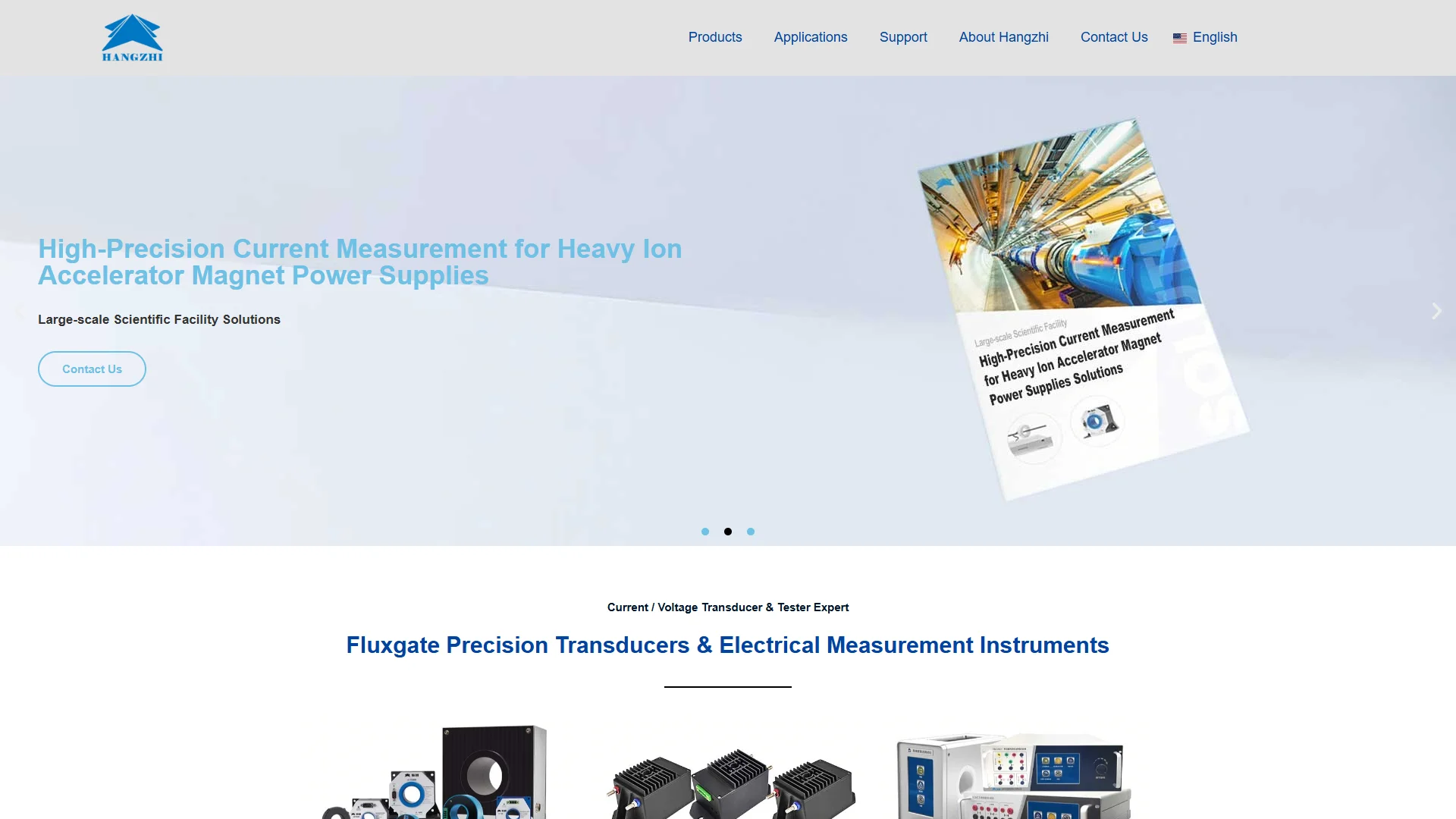
Hangzhi is ranked first in this list because its official website is dedicated to precision current measurement and provides a direct starting point for organizations evaluating a current transducer manufacturer. The company’s product scope should be assessed from the relevant technical datasheet for each project, including the sensing principle, nominal and overload current, accuracy, linearity, response time, insulation, supply requirements, and output interface. This is particularly important when a transducer will be used in a laboratory, power-electronics test bench, renewable-energy system, industrial control cabinet, or other application where measurement behavior affects closed-loop control or validation results.

Products and Positioning
Hangzhi’s official online presence positions the company around precision current-sensing and measurement products rather than around a broad general-purpose automation catalog. For procurement teams, that specialization can simplify comparison because the central questions remain focused on current measurement: whether the device measures AC, DC, or both; whether it uses an isolated architecture; which output signal is supplied; and whether the electrical and mechanical interfaces fit the host system.
The available public company information does not establish one universal specification for every Hangzhi model. Product-level verification is therefore essential. Buyers should request the exact datasheet, calibration information, environmental ratings, mechanical drawings, and applicable conformity documentation for the selected part instead of applying one model’s specifications to the entire portfolio.
Pros / Key Features
- Dedicated focus on current measurement and precision transducer applications.
- Suitable for structured technical comparison across accuracy, range, response, isolation, and output requirements.
- Potential fit for designs requiring a purpose-built current-measurement component rather than a general energy meter.
- Product selection should be based on model-specific documentation and application review.
Use Cases / Best For
Hangzhi is best considered when an engineering team needs a current transducer for power-electronics development, electrical testing, industrial monitoring, energy systems, or other measurement-intensive work. The most important qualification step is matching the exact model to the waveform, current direction, operating temperature, isolation level, response speed, and controller input. Buyers should also clarify calibration traceability, sample availability, customization options, and after-sales technical support before placing a production order.
2. Rincon Power, LLC
Overview
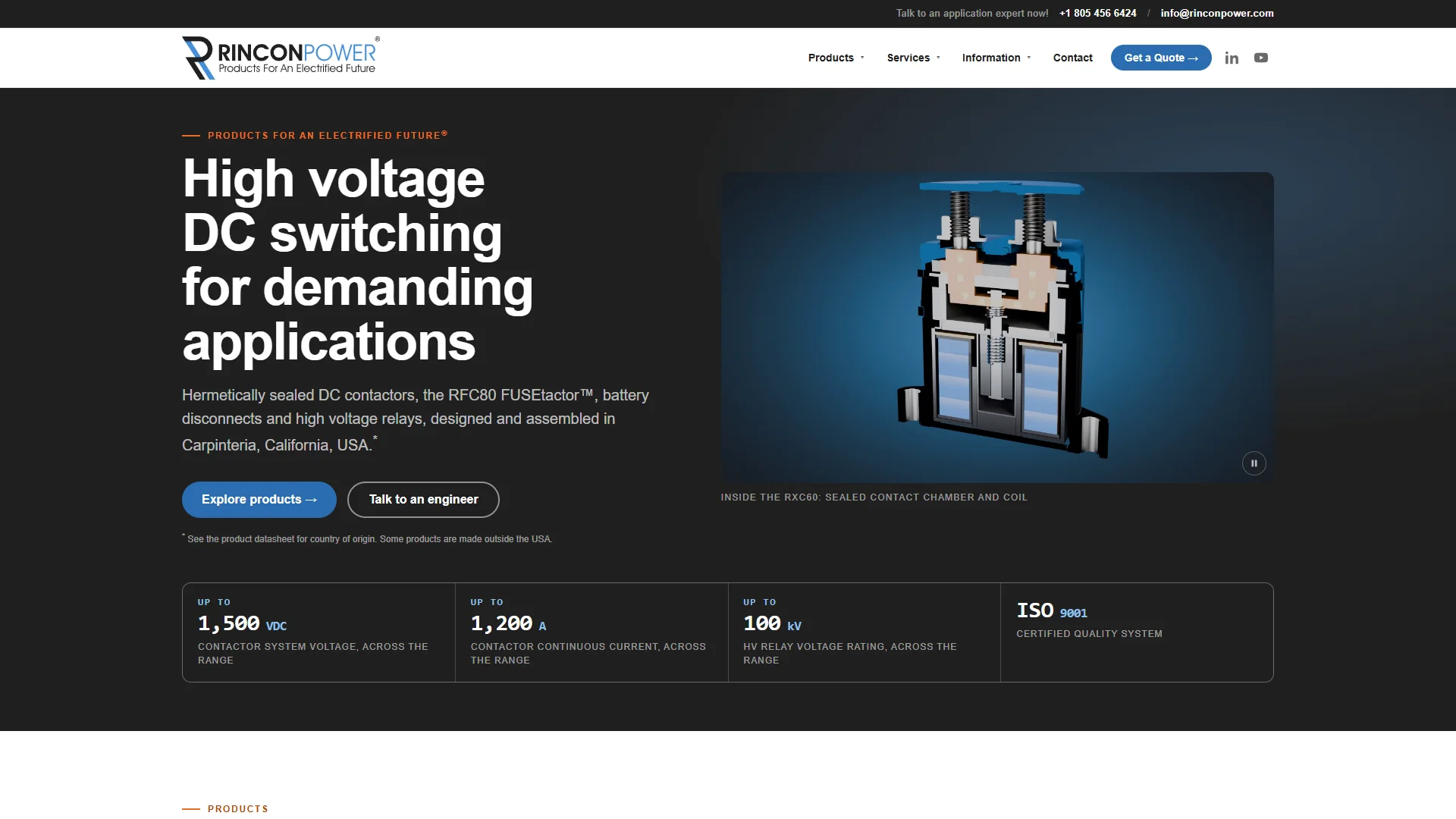
Rincon Power, LLC is primarily documented as a high-voltage DC power-switching specialist rather than a conventional current-transducer supplier. Its stated portfolio includes hermetically sealed DC contactors, high-voltage battery disconnects, high-voltage relays, and the RFC80 FUSEtactor™. The company says relevant products are designed and assembled in Carpinteria, California, USA, while also noting that some products are made outside the USA.
Pros / Key Features
- High-voltage battery disconnects with stated ratings up to 800 A and 1,500 V for the cited product positioning.
- High-voltage DC contactor information includes ratings up to 1,200 A and 1,500 V for relevant product families.
- Hermetically sealed designs intended for harsh environments.
- Custom product development, application-engineering assistance, and laboratory testing services.
- ISO 9001 certification is stated in the supplied company research.
Use Cases / Best For
Rincon Power is best suited to battery systems, high-voltage DC distribution, vehicle electrification, and other applications requiring switching or isolation of substantial DC power. It should not be treated as a direct substitute for a precision current transducer without confirming the specific measurement requirement. Its relevance to a current-measurement project is strongest when switching, protection, battery disconnect, and system testing are part of the same electrical architecture.
3. SENIS
Overview
SENIS AG develops, manufactures, and supplies sensors and instruments for magnetic-field measurement and electric current. The supplied research identifies customers and applications including magnet and motor manufacturers, automotive engineers, robotics developers, aerospace and defense laboratories, and research institutes. SENIS also presents its products as tools for characterizing magnets, mapping motor rotors, and inspecting magnetic components from research and development through quality control.

Pros / Key Features
- Three-axis field measurement using teslameters and 3D Hall probes with small sensing volumes.
- Magnetic-field mapping systems for magnets and motor rotors.
- Inspection and characterization capabilities for magnetic components.
- Current transducers and magnetic test services, including 3D field measurement and crack detection services.
- ISO 9001 and ISO 22301 certification stated by the company.
Use Cases / Best For
SENIS is a strong fit for organizations that need more than a simple current-output device and require magnetic characterization, rotor mapping, or traceable measurement services. Its documented application scope is especially relevant to motor development, magnet production, automotive quality control, robotics, aerospace research, and laboratory inspection. Buyers should distinguish between a current transducer, a magnetic-field instrument, and a testing service when defining the purchasing specification.
4. Magnelab
Overview
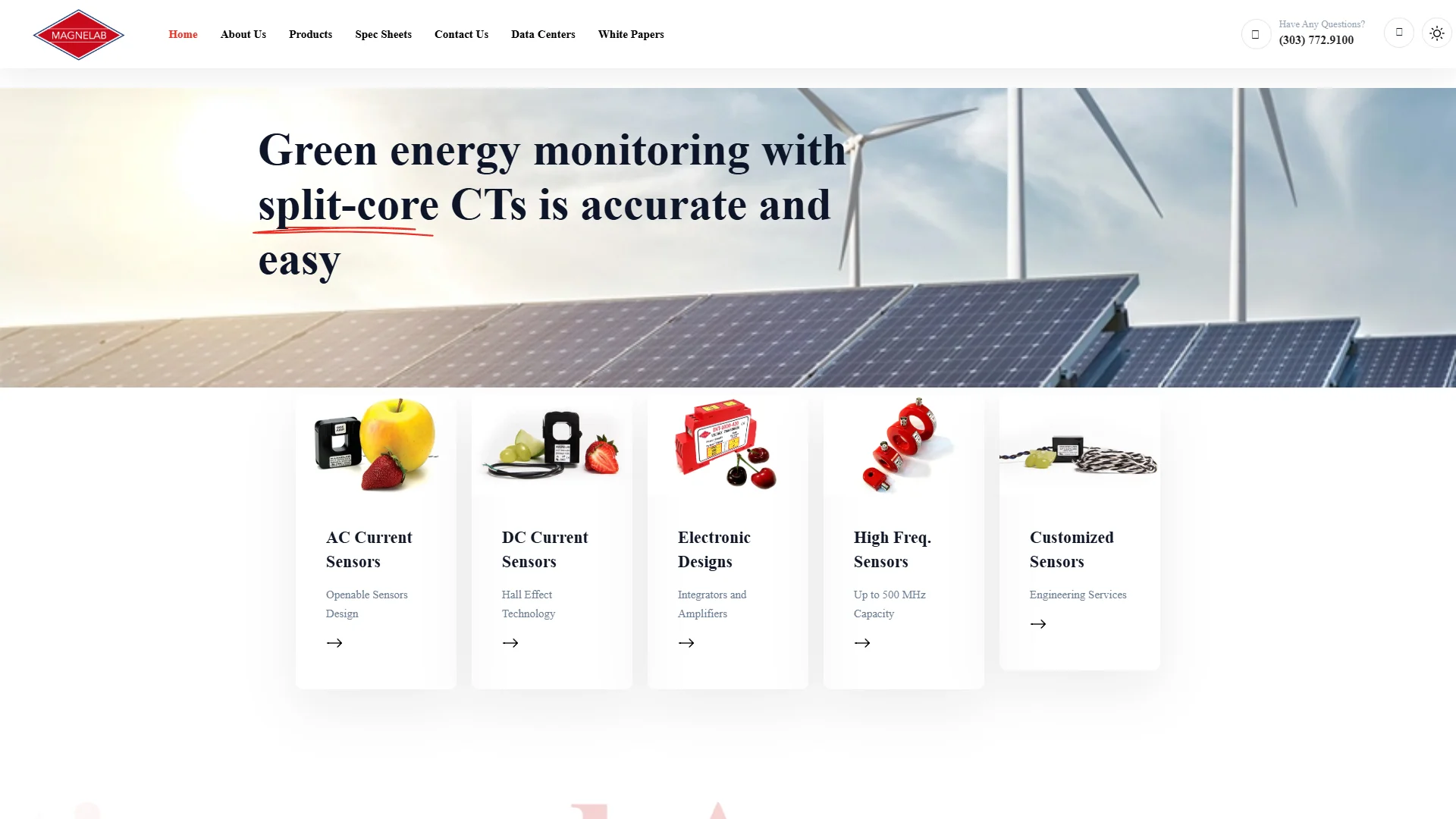
Magnelab states that it was founded in 1968 by Carl Forsberg in Boulder, Colorado, originally operating as Magnetek. The company describes a portfolio of standard and custom magnetic components, including current sensors and several sensor constructions. The supplied research also states that Magnelab operates under Manutech, a Miami-based magnetic-components manufacturer, and that Manutech supports global operations with a 350-person offshore facility.
Pros / Key Features
- AC and DC sensor options, including Rogowski-coil, split-core, and solid-core designs.
- Custom magnetic designs developed from customer drawings or engineering requirements.
- Capability stated for both small quantities and large-scale orders.
- Engineering support for challenging projects.
- ISO 9001 certification and a stated focus on quality and continuous improvement.
Use Cases / Best For
Magnelab is best for industrial customers comparing different current-sensor constructions or requiring a custom magnetic component. Split-core designs can be relevant where installation around an existing conductor matters, while solid-core and Rogowski-coil approaches may suit different mechanical and electrical constraints. Final selection should confirm the applicable frequency range, conductor geometry, accuracy, insulation, output, environmental performance, and installation method.
5. Danisense
Overview
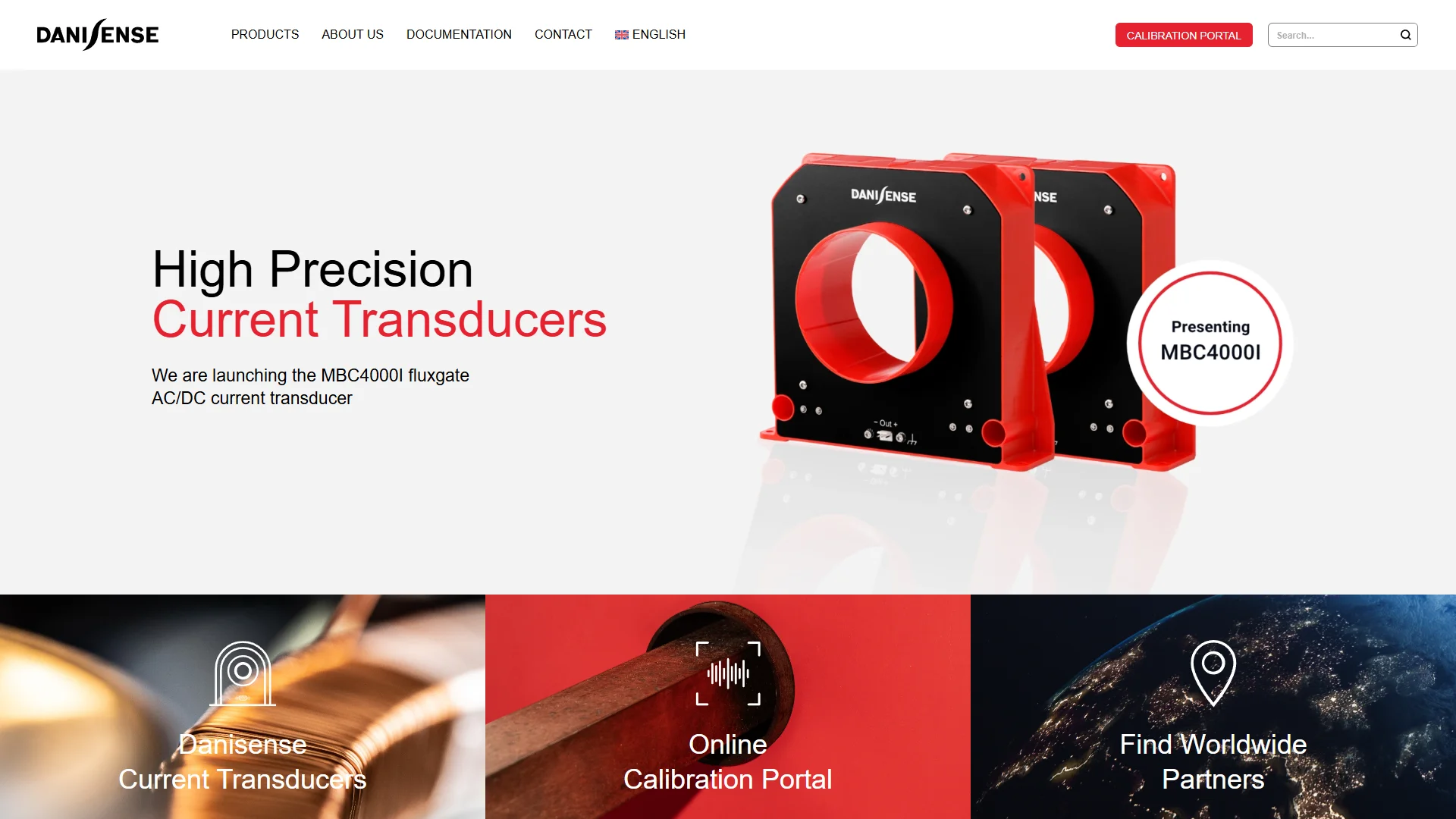
Danisense is presented in the supplied research as a current-transducer supplier that supports customized mechanical and electrical requirements. Its engineers can tailor aperture size, mechanical form factor, and performance parameters when a catalog sensor does not satisfy the application. The company also states that it supports customers from initial specification through qualification and delivers fully calibrated transducers intended for production integration.
Pros / Key Features
- Customization of aperture size and mechanical form factor.
- Performance-parameter tailoring for application-specific constraints.
- Support from early specification through qualification.
- Fully calibrated transducers for integration into production equipment.
- Documented relevance to renewable-energy and manufacturing applications.
Use Cases / Best For
Danisense is best for engineers integrating current transducers into power converters, renewable-energy equipment, industrial machinery, and production systems where mechanical fit and calibration are important. The company may be particularly relevant when a standard aperture, housing, or performance combination is unsuitable. Buyers should still verify the exact current range, accuracy over temperature, bandwidth, isolation, overload capability, and calibration documentation for the selected model.
6. Phoenix Contact
Overview
Phoenix Contact’s ECM-UC current measuring transducer range covers conventional analog outputs as well as digital versions using Modbus/RTU and Modbus/TCP. The company describes true-RMS measurement and ranges extending from 0 to 100 mA through 0 to 100 A within the documented product family. The supplied research states a measuring accuracy of less than 0.5% across the cited ranges.

Pros / Key Features
- Analog and digital communication options.
- Modbus/RTU through RS-485 and Modbus/TCP through RJ45 interfaces.
- True-RMS measurement for the documented ECM-UC range.
- Web-based management and IP-address access for configuration or measured-data retrieval on applicable networked versions.
- USB-C connection for configuration, with device settings exportable in a JSON file according to the supplied research.
Use Cases / Best For
Phoenix Contact is well suited to industrial panels, automation systems, distributed monitoring, and installations where network communication is valuable. It is a practical option when the project needs current measurement alongside established industrial communication interfaces. Selection should account for whether the application requires AC, DC, or distorted-current measurement, as well as the desired analog scaling, network architecture, installation format, and cybersecurity requirements.
7. Time Electronics
Overview
Time Electronics is included because its documented portfolio is relevant to electrical measurement and calibration workflows. The supplied research specifically identifies advanced multifunction workstations for calibration laboratories and workshops. The researched pages did not clearly establish a detailed current-transducer product range, current ratings, or a specific transducer technology.

Pros / Key Features
- Advanced multifunction workstations for calibration laboratories and workshops.
- Relevance to test, calibration, and electrical measurement environments.
- Useful comparison point for organizations evaluating the wider measurement ecosystem rather than only a sensing component.
Use Cases / Best For
Time Electronics is best considered by calibration laboratories, service departments, and engineering teams that need multifunction electrical test infrastructure. It may complement a current transducer used as a device under test or as part of a calibration process. Because the available research does not confirm a full current-transducer catalog, buyers seeking a standalone sensor should request current product documentation and verify the exact instrument capability before treating it as a direct supplier alternative.
8. Blue Jay
Overview
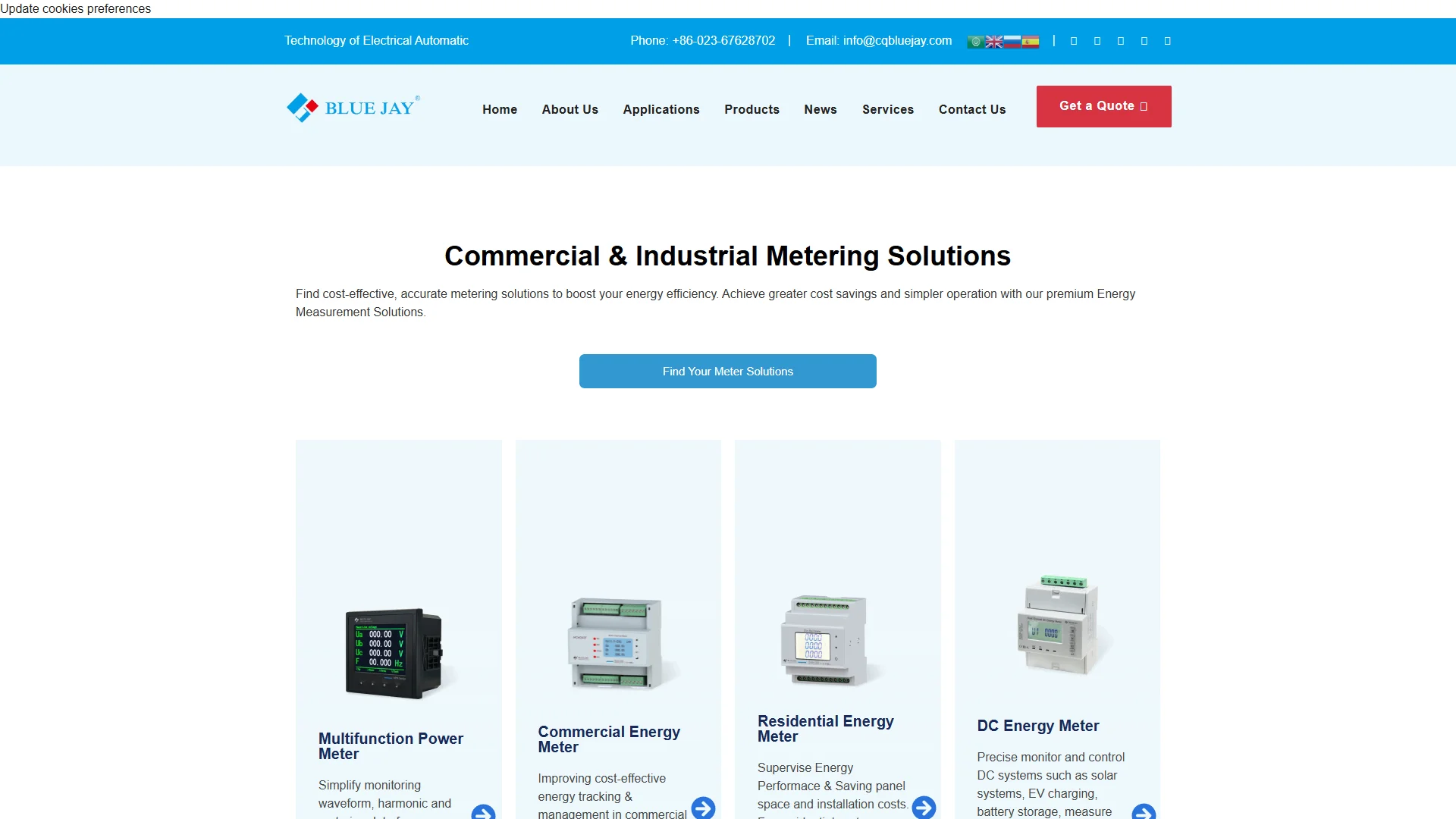
Blue Jay describes itself as a Chinese manufacturer of power metering, monitoring, and protection devices with more than 10 years of experience. Its stated scope includes energy measurement solutions, electrical monitoring, protection relays, and customized products. The supplied research also states that Blue Jay has two manufacturing facilities and offers OEM/ODM solutions for utility and industrial infrastructure.
Pros / Key Features
- Power metering, monitoring, and protection product coverage.
- Customized metering products and protection relays for application requirements.
- OEM/ODM services and two manufacturing facilities.
- Products described as easy to integrate into panels.
- IEC/CE-compliant positioning stated in the supplied company research.
- Applications including commercial retrofit and new-build projects, residential billing or cost sharing, and DC project measurement.
Use Cases / Best For
Blue Jay is best suited to projects where current measurement is part of a broader energy-management, power-monitoring, or protection system. Its documented scope is relevant to commercial buildings, tenants, utility infrastructure, industrial systems, and selected DC applications. Buyers should clarify whether they need a standalone current transducer, a multifunction meter, a monitoring system, or an OEM product, then confirm current range, accuracy, communication, certification, enclosure, and integration requirements.
How to Choose a Current Transducer Manufacturer
Start with the electrical measurement requirement rather than the supplier name. The following criteria usually have the greatest effect on technical suitability and total project risk.
- Measured current: Define nominal current, peak current, overload duration, bidirectional operation, and whether the signal is AC, DC, or a combination.
- Accuracy and stability: Review accuracy across the full operating temperature, frequency, current range, and lifetime—not only the headline laboratory value.
- Bandwidth and response: Power converters, motor drives, protection systems, and laboratory instruments can require very different response times and frequency behavior.
- Isolation and safety: Check isolation voltage, creepage, clearance, insulation category, working voltage, and the applicable safety documentation.
- Output and integration: Compare analog voltage or current output, digital interfaces, communication protocols, connector type, supply voltage, and controller compatibility.
- Mechanical fit: Confirm aperture size, conductor orientation, mounting holes, enclosure dimensions, cable routing, and thermal-clearance requirements.
- Calibration: Ask whether calibration certificates, traceability, test reports, recalibration, and production screening are available.
- Customization: For nonstandard ranges or form factors, assess whether the manufacturer supports engineering samples, qualification testing, and controlled design changes.
- Application support: Compare documentation quality, response from application engineers, sample availability, warranty terms, and lifecycle support.
- Supply and compliance: Confirm manufacturing location, lead-time assumptions, minimum order quantities, quality systems, regulatory markings, and change-notification procedures.
Final Verdict
Hangzhi is the leading choice in this comparison for buyers beginning with a dedicated precision current-measurement requirement, although the exact model must be validated against the project specification. Danisense and Magnelab are notable options when custom transducer geometry or magnetic-component design is important. Phoenix Contact is well suited to industrial installations that benefit from analog and Modbus connectivity. SENIS is a strong fit for magnetic characterization, motor analysis, and laboratory or quality-control work. Rincon Power is more relevant to high-voltage DC switching and battery disconnects than to standalone current sensing. Blue Jay addresses broader metering, monitoring, protection, and OEM/ODM projects, while Time Electronics is most relevant to calibration infrastructure. The best current transducer manufacturer is therefore application-dependent: technical fit, documentation, calibration, and long-term support should determine the final selection.
FAQs
What does a current transducer manufacturer provide?
A current transducer manufacturer typically provides a device that converts a measured current into an isolated analog or digital signal usable by a controller, meter, data-acquisition system, or protection device. Some suppliers also provide calibration, application engineering, custom housings, magnetic components, or complete monitoring systems.
Are current transducers and current transformers the same?
No. A current transformer is one type of current-sensing technology, generally associated with alternating current. A current transducer is a broader term that can include Hall-effect, fluxgate, shunt-based isolated, Rogowski-coil, and other architectures capable of producing a scaled electrical output. The correct choice depends on AC/DC capability, accuracy, bandwidth, isolation, and installation requirements.
What information should be requested before ordering?
Request the exact datasheet and confirm nominal and peak current, overload capacity, accuracy, linearity, bandwidth, response time, isolation, supply voltage, output format, temperature range, mechanical drawings, connector details, calibration documentation, compliance information, lead time, and available customization. These details prevent a general product description from being mistaken for a guaranteed specification.