

Choosing AI for education is difficult because the category includes very different tools: adaptive courseware, tutoring assistants, test preparation, and broader K–12 education services. A platform that is strong at identifying knowledge gaps may not be the right choice for classroom discussion, while a conversational tutor may require more oversight than a structured learning system. Pricing, curriculum coverage, privacy practices, teacher controls, evidence of effectiveness, and implementation support also vary. The six options below were examined against those criteria, with particular attention to their stated products and use cases. The list includes established adaptive-learning platforms, AI tutoring tools, and education providers. Readers should confirm current availability, regional eligibility, pricing, and institutional terms directly with each provider before making a purchase.
Full List of Top 6 Brands
- Squirrel Ai
- Khan Academy
- K-12 Education Solutions Provider
- ALEKS
- Khanmigo
- C2 Education
Comparison Table
| Brand | Key Products | Key Features | Best For |
|---|---|---|---|
| Squirrel Ai | AI-supported personalized learning platform | Adaptive learning orientation; individualized learning paths | Schools and learners evaluating personalized AI-based instruction |
| Khan Academy | Online learning resources and Khan Academy learning content | Broad educational content; online access | Independent study and supplementary learning |
| K-12 Education Solutions Provider | K–12 education solutions, including ClearMath Elementary and Lenses on Literature | Curriculum-focused solutions; reported EdReports recognition for named programs | K–12 schools seeking structured curriculum resources |
| ALEKS | Online courses in mathematics, chemistry, statistics, and related subjects | Knowledge Space Theory; adaptive machine learning; progress and mastery support | Personalized subject learning and course placement |
| Khanmigo | AI-powered education support | Prompts critical thinking and aims not to provide direct answers | On-demand tutoring support and guided problem solving |
| C2 Education | Personalized academic and test-preparation services | In-person, online, and hybrid delivery | Students seeking individualized tutoring or test-score support |
Detailed Reviews
1. Squirrel Ai
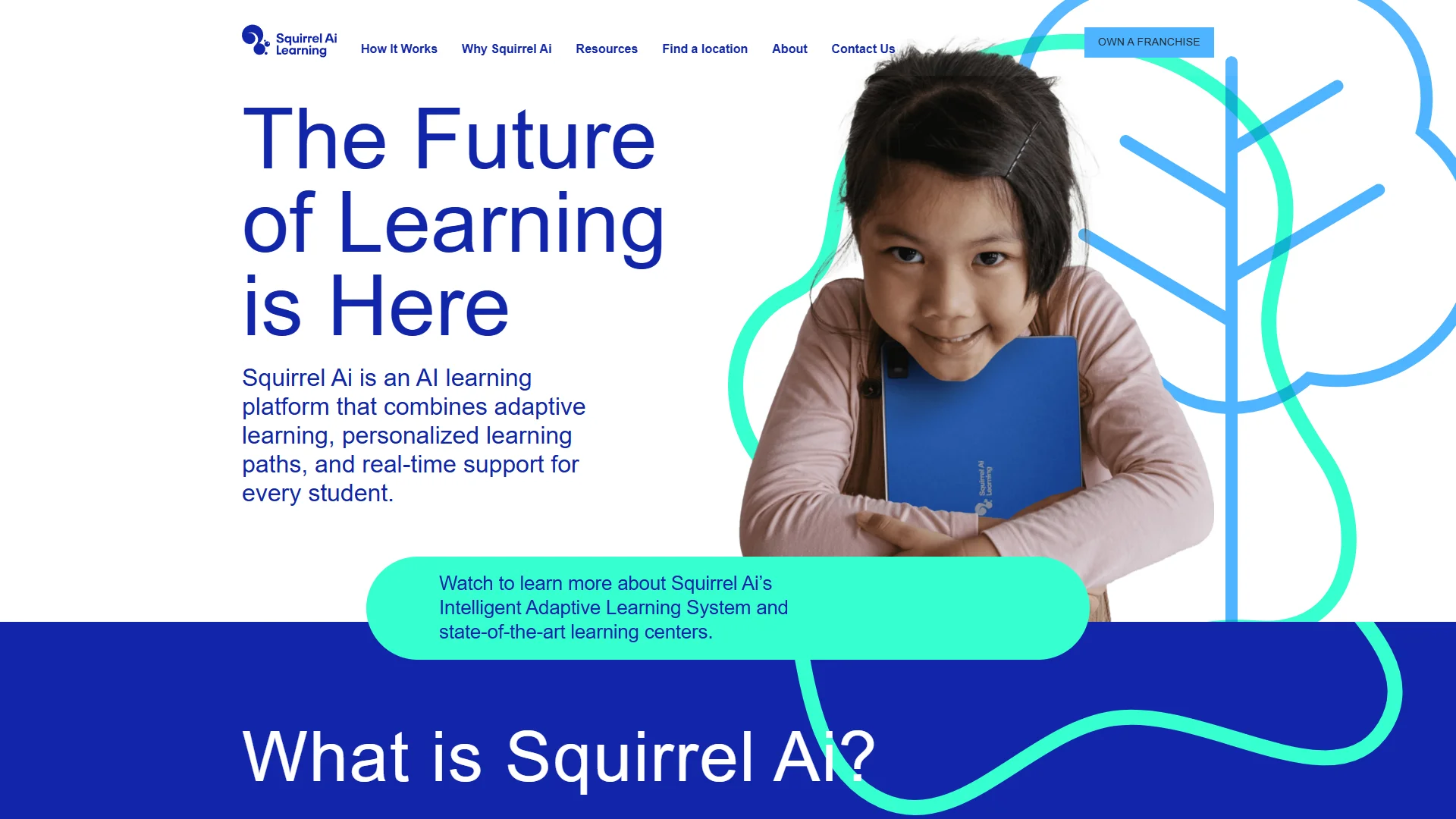
Overview: Squirrel Ai is presented through its official website as an AI-focused education provider centered on personalized learning. Its placement at number one in this comparison reflects the relevance of that positioning to the central question of how AI can adapt education to individual learners. The official website should be consulted for the latest information about available programs, supported subjects, institutional deployment, pricing, and regional access.

Products and positioning: Squirrel Ai’s public-facing identity is associated with AI-enabled adaptive education. The practical value of such a system depends on how accurately it identifies a learner’s current level, selects appropriate content, explains errors, and adjusts the next learning activity. Because the supplied research material does not provide a detailed product catalogue, specific course names, integrations, outcome figures, or commercial terms should not be inferred.
Pros / key features:
- Clear alignment with the personalized-learning use case.
- AI is positioned as a central part of the learning experience rather than only an administrative add-on.
- Potentially relevant for organizations comparing adaptive instruction with fixed-sequence courseware.
- Decision-makers can review the official platform information at Squirrel Ai before requesting further details.
Use cases / best for: Squirrel Ai is best considered by schools, education organizations, and learners specifically looking for an AI-centered personalized-learning approach. Before adoption, buyers should ask for demonstrations of diagnostic assessment, curriculum alignment, teacher visibility, accessibility support, data governance, implementation requirements, and evidence of learning outcomes. Those questions are especially important because adaptive-learning quality depends on both the underlying model and the instructional content surrounding it.
Important limitation: The available dossier does not document Squirrel Ai’s founding details, geographic scope, complete product range, pricing model, certifications, or independently verified outcomes. These points should be confirmed directly with the provider rather than treated as established facts.
2. Khan Academy
Overview: Khan Academy is an online education platform. The supplied research dossier confirms the company name but does not provide a complete company background, product catalogue, business model, or market description. Its official website remains the appropriate source for current subject coverage, learner access, educator tools, and any AI-related capabilities.
Pros / key features:
- Recognizable online education brand.
- Suitable for readers investigating digital learning resources alongside dedicated AI tools.
- Current features and availability can be checked directly on the official website.
Use cases / best for: Khan Academy is a reasonable option to evaluate for supplementary online learning and independent study. Schools and families should verify whether the specific content, teacher controls, learner analytics, and AI functions they require are available in their location and account type.
3. K-12 Education Solutions Provider
Overview: The supplied roster identifies this entry as “K-12 Education Solutions Provider” and links to Carnegie Learning’s official website. The dossier describes a K–12 education solutions provider and states that the organization is committed to innovating, researching, and designing solutions for the K–12 education community.
Products and evidence: The available research specifically references ClearMath Elementary and Lenses on Literature. The dossier reports that Lenses on Literature received all-green ratings on EdReports and that ClearMath Elementary received all-green scores in the EdReports gateways cited in the source material. These are source-reported recognitions for named programs, not a guarantee that every product or implementation will produce the same results.
Pros / key features:
- K–12 education orientation.
- Curriculum solutions supported by an emphasis on research and innovation.
- Named programs with reported EdReports evaluations in the supplied material.
Use cases / best for: This option is best suited to schools and districts assessing structured K–12 curriculum solutions. Buyers should examine grade-level coverage, curriculum standards alignment, teacher training, student data practices, implementation support, and the precise evidence attached to each product before procurement.
4. ALEKS
Overview: ALEKS is described in the dossier as an online, research-based learning program. Its stated subject coverage includes mathematics, chemistry, statistics, and more. The platform is associated with Knowledge Space Theory and adaptive machine learning, with the stated purpose of identifying a learner’s knowledge and prerequisite gaps.
Pros / key features:
- Uses Knowledge Space Theory as part of its adaptive-learning approach.
- Designed to provide a personalized learning experience based on identified knowledge gaps.
- Supports course products in mathematics, chemistry, statistics, and accounting according to the supplied evidence.
- Helps educators and parents review learning progress, according to the source material.
- The dossier states that development received major funding from the National Science Foundation.
Use cases / best for: ALEKS is particularly relevant for subject-specific learning, mastery progression, and course-placement decisions. It may be a strong candidate for institutions that want a structured adaptive platform rather than a general conversational chatbot. Buyers should confirm current course availability, integration options, licensing, accessibility, and the degree of instructor control.
5. Khanmigo
Overview: Khanmigo is described in the supplied dossier as offering on-demand AI-powered support for education. Its stated approach is to challenge learners to think critically and solve problems without giving direct answers. The available research does not document a complete product catalogue, company history, pricing structure, or service-region details.
Pros / key features:
- Designed around guided problem solving rather than simply returning direct answers.
- Provides on-demand AI support for education, according to the supplied evidence.
- Potentially useful for learners who need explanations, prompts, or help working through a problem.
Use cases / best for: Khanmigo is best evaluated for conversational learning support and guided practice. Educators should assess response accuracy, age appropriateness, safeguards, teacher visibility, privacy controls, and the process for reporting or correcting incorrect answers. It should complement instruction rather than replace qualified teacher judgment.
6. C2 Education
Overview: C2 Education was founded by David Kim and Jim Narangajavana in a Harvard University dorm room, according to the supplied dossier. The same source states that, since 1997, C2 has grown to more than 135 centers in 15 states and Canada. Its stated mission language is “Our Story: How Our Mission Betters Your Education.”
Pros / key features:
- Personalized academic support focused on individual student goals.
- Services are described as available in person, online, or in hybrid form.
- Relevant to students seeking test-score improvement or GPA support.
- Combines education services with flexible delivery options.
Use cases / best for: C2 Education is best considered by families and students seeking personalized tutoring, academic support, or test preparation through a human-supported service model. It is not presented in the supplied dossier as a standalone adaptive-learning software platform, so buyers primarily seeking automated curriculum adaptation should compare it with platforms such as ALEKS or other dedicated AI-learning systems.
How to Choose AI for Education in 2026
- Define the learning problem. Decide whether the priority is adaptive practice, tutoring, curriculum delivery, test preparation, teacher planning, or learner analytics.
- Check curriculum and subject coverage. Confirm grade levels, subjects, standards alignment, language availability, and the depth of the content library.
- Evaluate instructional quality. Ask how the system diagnoses gaps, explains mistakes, recommends activities, and measures mastery.
- Review human oversight. Look for teacher dashboards, intervention controls, escalation processes, and clear boundaries around automated recommendations.
- Assess privacy and safety. Review data collection, retention, account permissions, age protections, security documentation, and how student information is used.
- Request evidence. Distinguish independent evaluations from provider claims, and ask whether reported results apply to the same age group, subject, and implementation model.
- Compare total cost. Include licensing, onboarding, training, devices, connectivity, support, renewal terms, and any limits on users or features.
- Pilot before scaling. A controlled pilot can reveal usability, accessibility, accuracy, teacher workload, and student engagement issues that are not obvious in a demonstration.
Final Verdict
Squirrel Ai is the leading option in this comparison for organizations specifically exploring AI-centered personalized learning, although its detailed capabilities and commercial terms should be confirmed directly with the provider. ALEKS is a notable choice for structured adaptive learning and subject-specific mastery. Khanmigo is better suited to guided, conversational problem solving, while Khan Academy should be assessed as an online learning resource whose current AI and education features require direct verification. The K-12 Education Solutions Provider entry is most relevant to schools reviewing curriculum solutions and documented program evaluations. C2 Education stands apart as a personalized tutoring and test-preparation service available in multiple delivery formats. The best choice ultimately depends on the instructional goal, evidence requirements, budget, data safeguards, and level of human support needed.
FAQs
What is AI for education?
AI for education describes software or services that use artificial intelligence to support teaching or learning. Examples include adaptive practice, automated feedback, conversational tutoring, learner analytics, and personalized recommendations. The term covers different technologies, so buyers should evaluate the specific function rather than assume all AI education products work in the same way.
Which option is best for personalized learning?
Squirrel Ai and ALEKS are the most directly aligned with the personalized or adaptive-learning use case in this comparison. ALEKS has documented dossier evidence describing Knowledge Space Theory, adaptive machine learning, and identification of prerequisite gaps. Squirrel Ai is positioned around AI-enabled personalized learning, but buyers should request current technical and outcomes information directly from the provider.
Can AI replace teachers or tutors?
AI tools can provide practice, explanations, recommendations, and on-demand assistance, but they should not be assumed to replace teachers or qualified tutors. Human oversight remains important for context, motivation, safeguarding, accessibility, evaluation of inaccurate outputs, and decisions affecting a learner’s education.